
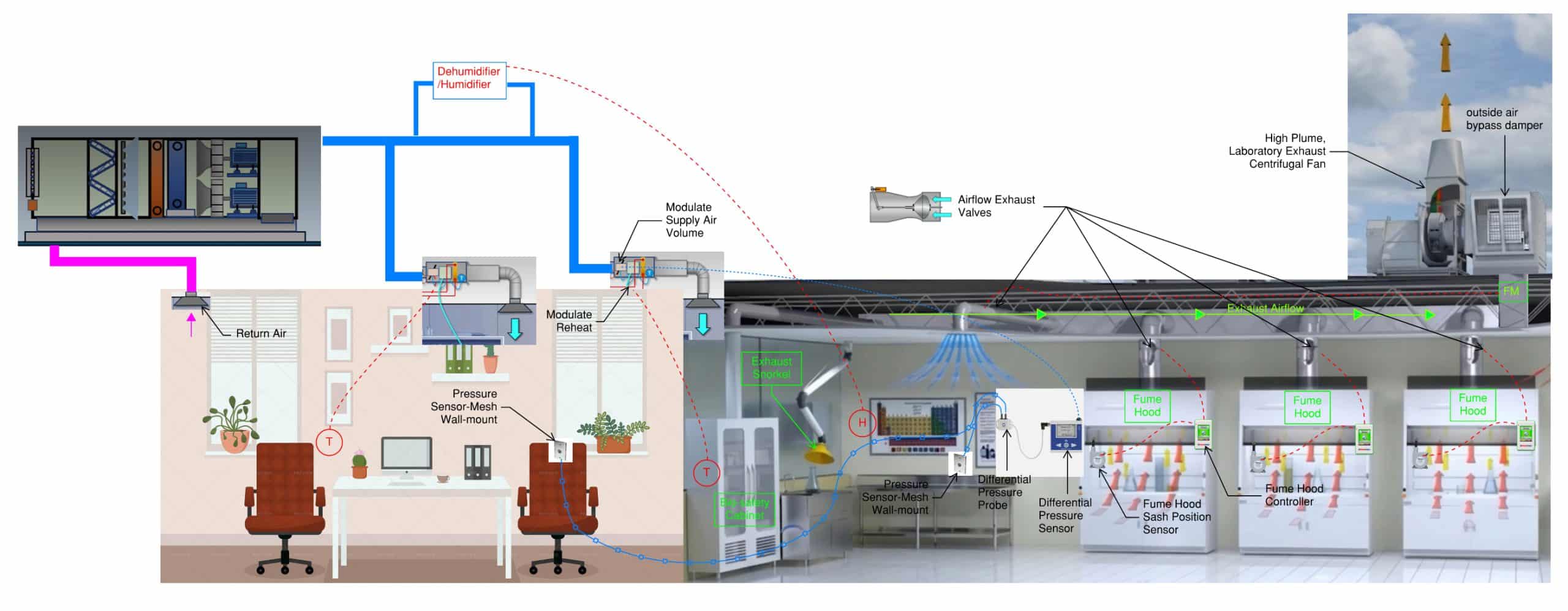
1. System Overview of Variable Volume Laboratory Exhaust Systems
The laboratory spaces are served by a Variable Volume Laboratory Exhaust System (VAV lab exhaust) designed to dynamically adjust airflow based on real-time demand from fume hoods and general exhaust requirements.
This approach ensures:
The system integrates advanced controls to balance safety, performance, and energy efficiency in modern laboratory environments.
2. California Energy Code 2025 Compliance (Title 24)
The system is designed in accordance with the California Energy Code 2025 (Title 24, Part 6), which requires laboratory exhaust systems to reduce airflow based on occupancy while maintaining safety and ventilation requirements.
2.1 Occupied Mode – Minimum Exhaust Airflow
When the laboratory is occupied, the exhaust airflow shall be maintained at the greater of the following:
2.2 Unoccupied Mode – Reduced Exhaust Airflow
Within 20 minutes of vacancy, airflow is reduced to the greater of the following:
2.3 Design Intent and Benefits
The system is designed to:
3. Laboratory Exhaust & Pressurization Control Strategy
The VAV laboratory exhaust system uses a smart, demand-based control strategy to maintain safety, comfort, and energy efficiency.
3.1 Fume Hood Demand Control
Each fume hood is equipped with a sash position sensor that continuously measures sash opening.
Based on sash position, the system:
3.2 Centralized Exhaust Airflow Calculation
All fume hood airflow demands are transmitted to the control system, where:
3.3 General Exhaust VAV Control
When hood demand is below the required minimum:
3.4 Exhaust Fan & Plume Control
The exhaust fan system modulates a bypass damper to maintain proper discharge velocity.
This ensures:
3.5 Room Pressurization Control
The laboratory is maintained at negative pressure relative to adjacent spaces.
This is achieved by:
3.6 Cooling Load Integration
When cooling demand increases:
This ensures:
3.7 Heating Mode Operation
During heating conditions:
Why Variable Volume Laboratory Exhaust System Design Matters
A properly designed Variable Volume Laboratory Exhaust System:
FAQ – Variable Volume Laboratory Exhaust Systems
A VAV laboratory exhaust system adjusts airflow dynamically based on real-time demand from fume hoods and occupancy levels to improve safety and energy efficiency.
Laboratories are maintained at negative pressure by ensuring exhaust airflow exceeds supply airflow, preventing contaminants from escaping to adjacent spaces.
Title 24 requires lab exhaust systems to reduce airflow during unoccupied periods while maintaining minimum safety and ventilation standards.